Friday, October 30, 2009

Extra Post: Midterm Critique Statement

Just as a refresher, I'm posting the statement I gave at my midterm critique yesterday:

My work this year is an attempt to deal with, and find humor in, my situation as a single mother. By appearing in my images multiple times, or once surrounded by multiples of my son, I hope to visually communicate that I am his sole caregiver and therefore pulled in a million directions. It is also my hope to convey a sense of liminality through my images, as I believe that I am in a liminal state between where I was, or want to be, and where I have to be.

I started out wanting to document some of the lonely and overwhelming moments I frequently encounter since being left alone in the parenting world. I pieced my images together in Photoshop, but none of the "mes" were interacting with each other. As a result, my first images were lonely and depressing, and almost depicted my child as more of an emotional burden than anything else. In addition, I was over-planning my shoots, separating them from my everyday motherly routines, and they were actually causing me to need a babysitter to keep Henry in the next room, so that he wasn’t part of what I was doing until it was his turn to be in front of the camera. That was not what I wanted at all.

As the semester progressed, I encountered a lot of technical difficulty in piecing my images together, and I was kind of forced by a dead computer to take a different approach. I started making my shoots more organic, taking pictures with a remote while going about my daily routine and interaction with Henry, and I began to physically cut and paste my images together, turning my photographs into collages. This allowed me to truly make my work about motherhood rather than acting for the camera, and I feel that the collages are functioning as a better metaphor for liminality than pristinely Photoshopped images would. They are also better able to communicate that, even though I’m the only parent, I have fun and I love what I’m doing.

I have struggled with this work all semester, and I continue to do so. I would love to make something that is visually beautiful, and these collages certainly aren’t. But they are about my life, and that isn’t exactly beautiful right now either. However, at the end of the day I come home to a person that loves me unconditionally, and I love being his mom, so I’m embracing the situation and embracing this work and I hope that it shows through my finished images.

Thursday, October 29, 2009

Research: Multi-Tasking

Everyone has to multi-task to some extent. Not only do I find myself constantly multi-tasking for school (going to class, studying, shooting, image editing, writing papers, etc) but I have to multi-task between my academic career and my role as mother (feeding, cooking, changing diapers, changing clothes, washing clothes, cleaning, picking up toys, playing, putting down for naps, comforting, reading stories, etc). Needless to say, it is extremely difficult.

In my images, I appear multiple times to try to demonstrate the constant activities/tasks I perform in taking care of my son. In the image where Henry appears as multiples and I am only there once, I am trying to demonstrate the energy he puts into everything he does, seemingly effortlessly, and my inability to keep up at times. Thinking about all of this led me to research multi-tasking.

Human multi-tasking or multitasking is the performance by an individual of appearing to handle more than one task at the same time. Some believe that multitasking can result in time wasted due to human context switching and apparently causing more errors due to insufficient attention. Since the 1990s, experimental psychologists have started experiments on the nature and limits of human multitasking. It has been shown multitasking is not as workable as concentrated times. In general, these studies have disclosed that people show severe interference when even very simple tasks are performed at the same time, if both tasks require selecting and producing action. Multi-tasking has also been shown to have a negative effect on happiness, as it only allows you to skim the surface of activities rather than give them your full attention. (See the article here.)

I feel that the definition and explanation above are pretty accurate for describing the way I feel about my constant juggling of various things. I find it extremely difficult to give my full attention to anything, but more often than not I give it to Henry, ignoring my homework and other daily tasks. I struggle with this because while I want to be a great mom, I want to keep up the grades I have worked so hard for over the last three years, I want to keep my house clean, I want to get enough sleep, and it goes on and on.

Hopefully my collages are depicting this multi-tasking struggle effectively. My midterm critique is this afternoon, so I guess I'll find out...

Sunday, October 25, 2009

Image Update

Finally, as promised, here are some of my collages. I'm trying to trust myself that they are what I wanted, but I honestly can't wait for critique to get some feedback...


Artist: Clare Murray Adams

I started looking at Clare Murray Adams because I had heard of her collage work, but found myself more drawn to her fiber pieces. She considers herself to be primarily a fiber artist, but incorporates collage, found objects, and encaustic paints on the surfaces of her fabric works. In viewing her work I detected a lot of themes of femininity, fertility, and domesticity, but here is what she has to say in her artist statement:
"
My work is often related in theme to aspects of memory, family history, spirituality, gender, time and space. While the specific occasions of memory are often of a personal nature, the themes and imagery have a universal appeal. My goal in making art is to explore process while allowing intuition to have its say."
I think of her work as being more of an experimental approach to collage, whereas my collages have been very straightforward. I would like to be brave enough to draw/paint on them, but I'm not sure how that relates to my concept unless it looks childish, and I won't know how I feel about that until I do it. Anyway, see a few of Adams' fiber pieces below.

SoulDoll

Four Days in May

Ticklish

Wednesday, October 21, 2009

Research: Child Art

During Griffin's midterm critique on Tuesday, Tom mentioned the term "Child Art." I was immediately curious as to whether this term applied to my work right now or not, so I did some research on the definition. The definition that I found right away was pretty narrow, as follows: "Child art is the drawings, paintings and other artistic works created by people under the age of 12. It is also referred to as 'children's art' or the 'art of children'. The term 'child art' also has a parallel and different usage in the world of contemporary fine art, where it refers to a sub-genre of artists who depict children in their works" (see article here).

I tried to find more information on this term, but what I found was mostly centered around art therapy in children that have been diagnosed with Autism or come from abusive homes. None of that applies to me.

Even though I could not find much information, this was not a waste. I still feel that I can confidently apply this term to my work - all of my images will contain Henry, and some may actually be manipulated by him - and any language that I can find to help describe what I am doing is helpful. Add this to the list of words I've been compiling for my project and it just might be taking shape...


Sunday, October 18, 2009

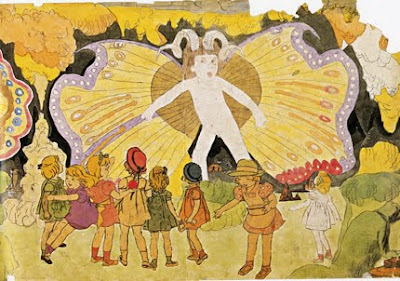
Artist: Henry Darger

Last week, Tom suggested that I take a look at Henry Darger's work, and I loved it so much I decided to make it my Sunday blog. Henry Joseph Darger, Jr. was a reclusive American writer and artist. He has become famous for his posthumously discovered 15,145-page, single-spaced fantasy manuscript called The Story of the Vivian Girls, in What is known as the Realms of the Unreal, of the Glandeco-Angelinnian War Storm, Caused by the Child Slave Rebellion, along with several hundred drawings and watercolor paintings illustrating the story. Darger's work has become one of the most celebrated examples of outsider art.
In 1968, Darger became interested in tracing some of his frustrations back to his childhood. It was in this year that he wrote
The History of My Life, a book that spends 206 pages detailing his early life before veering off into 4,672 pages of fiction about a huge twister called "Sweetie Pie," probably based on memories of the tornado he had witnessed in 1908. He also kept a diary to chronicle the weather and his daily activities. Darger often concerned himself with the plight of abused and neglected children; the institution where he had lived as a boy was brought under investigation in a huge scandal shortly before he left and he might have seen victims of child abuse in the hospital where he worked. (Read more here.)

In looking at Darger's work, I found that it was somewhat related to mine in terms of content (children), and technique. His paintings and drawings immediately remind me of collage, and they are a good source of inspiration for composition. I have been contemplating drawing on my collages, or allowing Henry to have a hand in them, and Darger's work definitely encourages me to at least try it out. Check out some of Darger's work below:


Thursday, October 15, 2009

Research: Master Narratives

As I continued to read Single by Chance, Mothers by Choice: How Women are Choosing Parenthood Without Marriage and Creating the New American Family by Rosanna Hertz this week, I learned about the concept of what sociologists refer to as a "master narrative."

According to Hertz, "Master narratives describe something that may once have been real but which has, over time, grown beyond its original proportions to become both the stuff of legend and a powerful form of social control. Through repetition, master narratives insinuate themselves into the cultural fabric, even when the ideal is rarely seen in reality" (p. 54). The ideal American family, complete with mother, father, children, and white picket fence, fits the role of a master narrative very well. I do not know anyone that has a perfect family, regardless of the parents' marital status, though it seems to be something that we all strive for.

For me and Henry, the ideal seems unattainable, yet the more I hesitate at this threshold of fully embracing my role as single mother, the more I become aware of the social constructs around me, and the more I long to fit them. According to Hertz, this is not unusual. "Single mothers are not out to change the world. In fact, they work diligently on behalf of their children, patching together a life that resembles the so-called normal middle-class family. Like all mothers, they strive to raise an acceptable child and to organize an acceptable family life" (p. 55).

As I consider my situation both in terms of my work and everyday life, I am constantly reminded of a concept I learned as a child: creating a "new kind of normal." As young children, my older brother and I shared a bedroom for a couple of years, and every night we would listen to "Odyssey" - a Christian radio program we had on CD that told funny stories geared at children and filled with moral values. The one I remember most was about dealing with change, and finding normalcy and happiness in a new situation. This is a challenge we are all faced with from time to time, and for me right now it is proving to be a slow and difficult process. Though I may actually be the happiest I have ever been in some ways - I absolutely adore being a mother! - I struggle to feel "normal," however abstract and subjective that feeling may be.

In the collages I have been working on (and will post soon, I promise!), I think these feelings are definitely coming across. It is not difficult to think of how cutting and pasting is a metaphor for fitting in and feeling normal. The difficult part is finding the language to express these feelings, and I feel like I have been making progress in that area lately. I continue to feel a new surge of inspiration and excitement for this project, and I am looking forward to seeing it through the rest of the year.